← All initiatives

Kaskel initiative · 28 prompts

AI Prompts at Work

28 ready-to-use prompts that turn an AI assistant into a research analyst, product coach or project manager. A practical way to catalyse your own skills at work.

How to use it: copy a prompt, replace the [highlighted parts] with your own details, and paste it into ChatGPT, Claude, Gemini or any AI assistant.

Part 1 · Prompts 1–9

Research & Insight

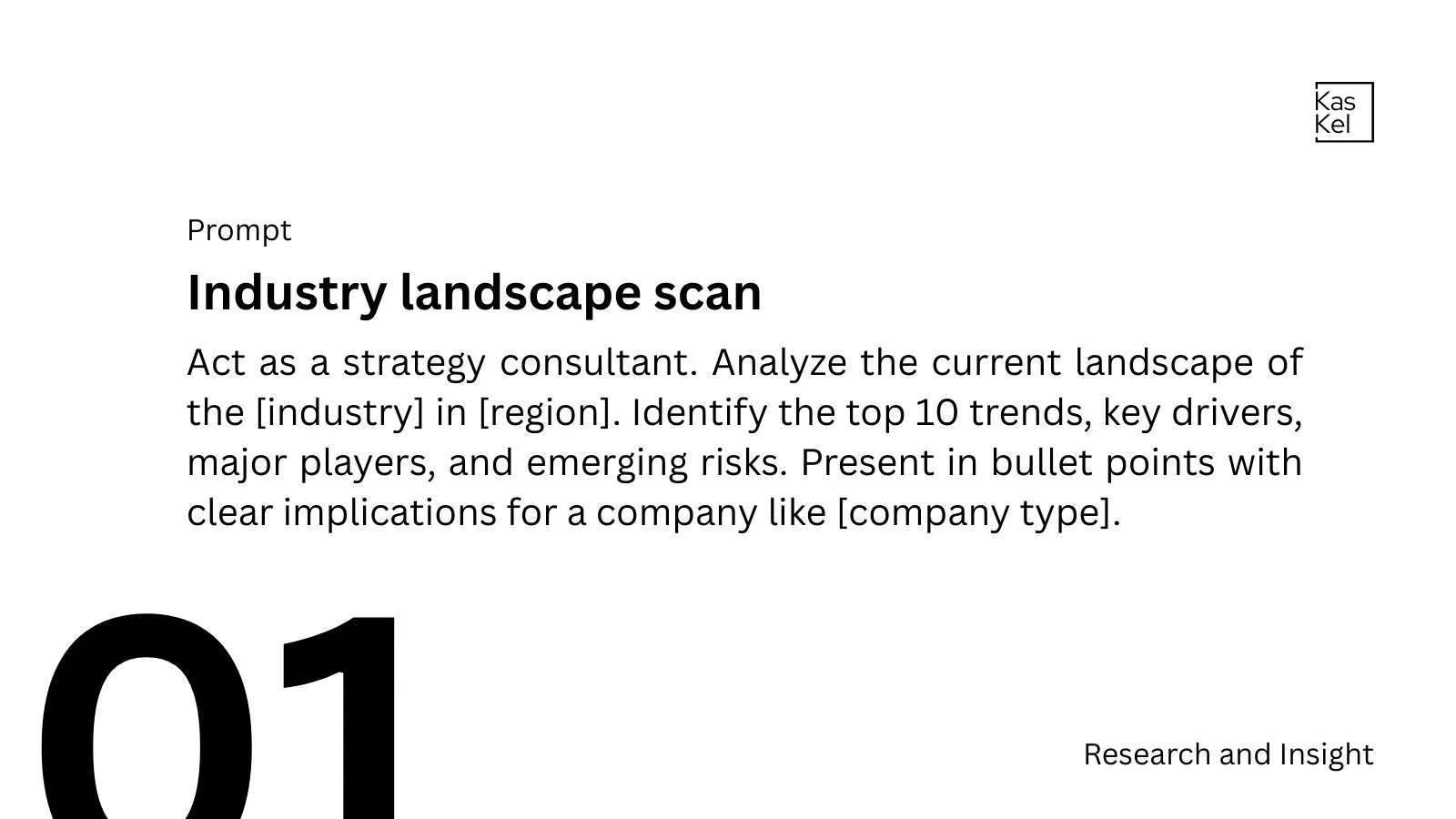
01

Industry landscape scan

Act as a strategy consultant. Analyze the current landscape of the [industry] in [region]. Identify the top 10 trends, key drivers, major players, and emerging risks. Present in bullet points with clear implications for a company like [company type].

View post
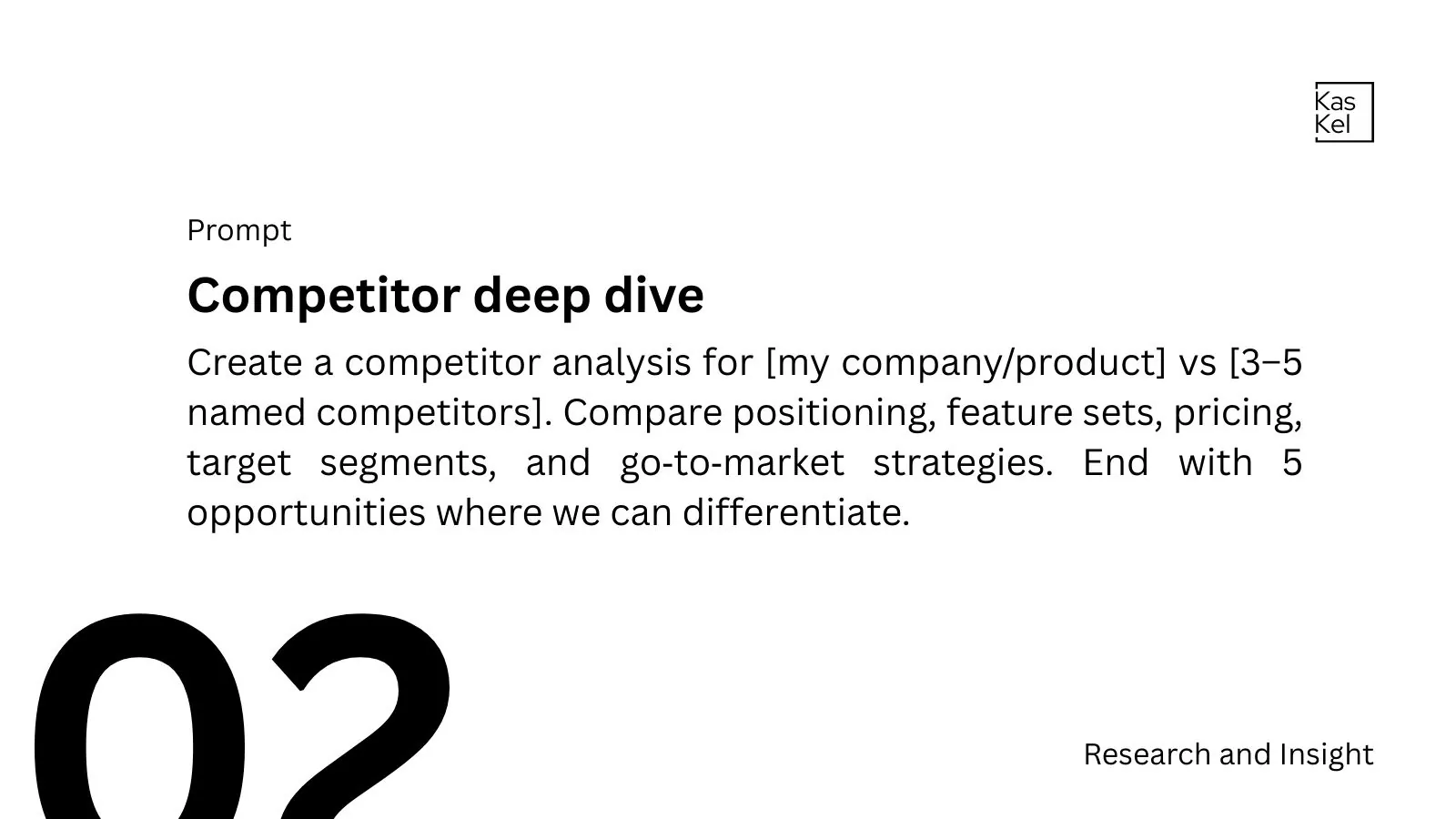
02

Competitor deep dive

Create a competitor analysis for [my company/product] vs [3–5 named competitors]. Compare positioning, feature sets, pricing, target segments, and go-to-market strategies. End with 5 opportunities where we can differentiate.

View post
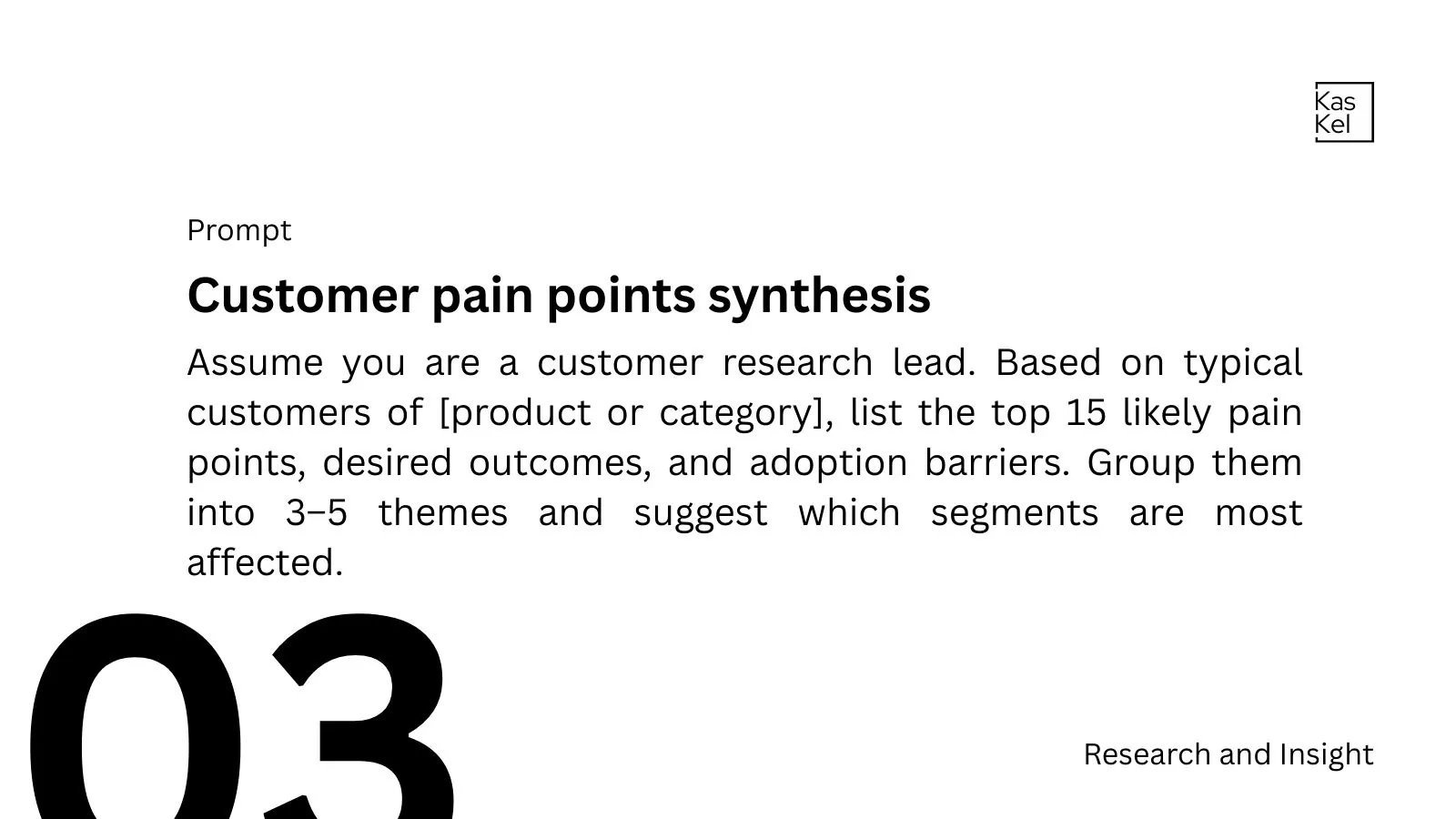
03

Customer pain points synthesis

Assume you are a customer research lead. Based on typical customers of [product or category], list the top 15 likely pain points, desired outcomes, and adoption barriers. Group them into 3–5 themes and suggest which segments are most affected.

View post
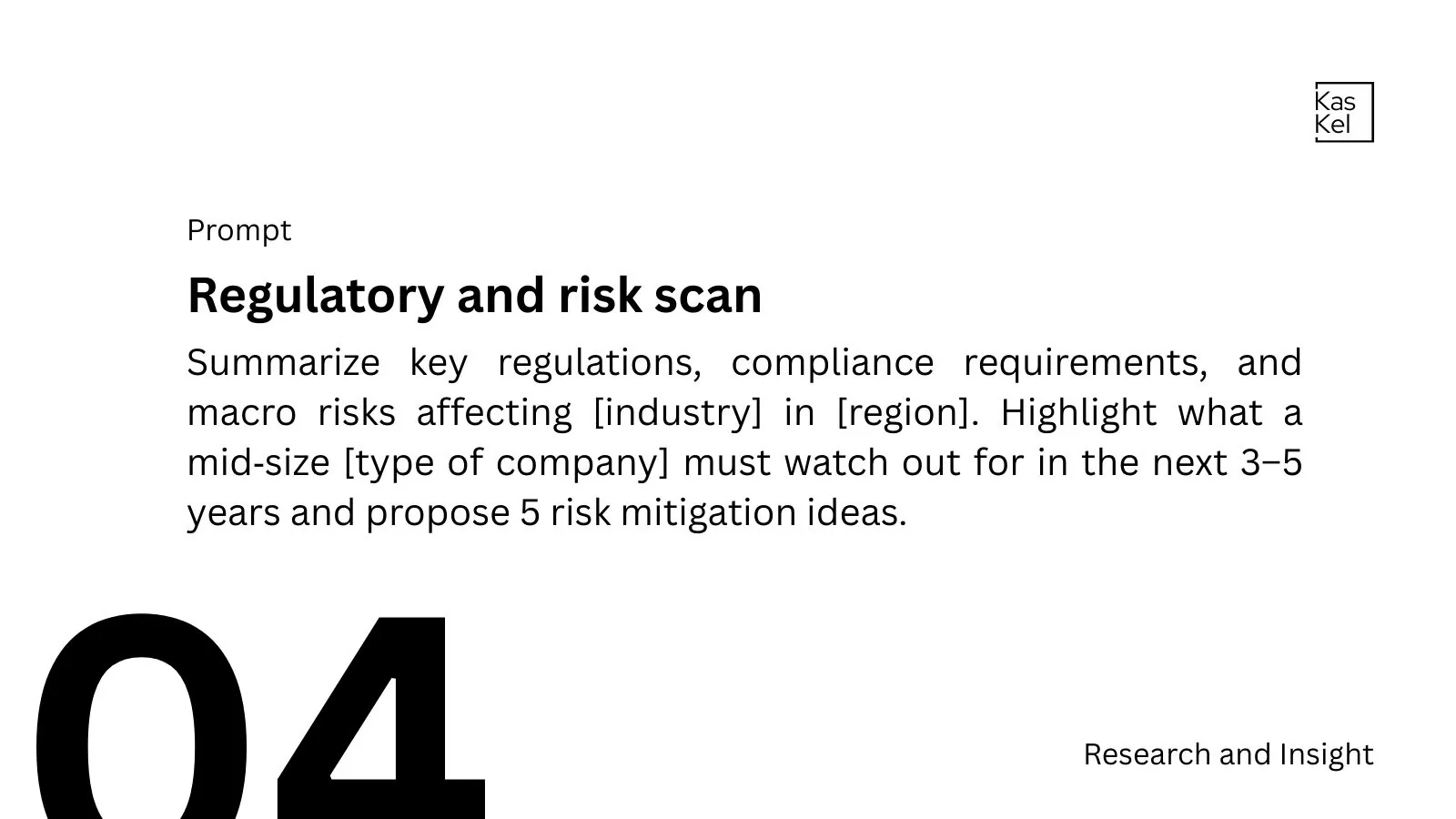
04

Regulatory and risk scan

Summarize key regulations, compliance requirements, and macro risks affecting [industry] in [region]. Highlight what a mid-size [type of company] must watch out for in the next 3–5 years and propose 5 risk mitigation ideas.

View post
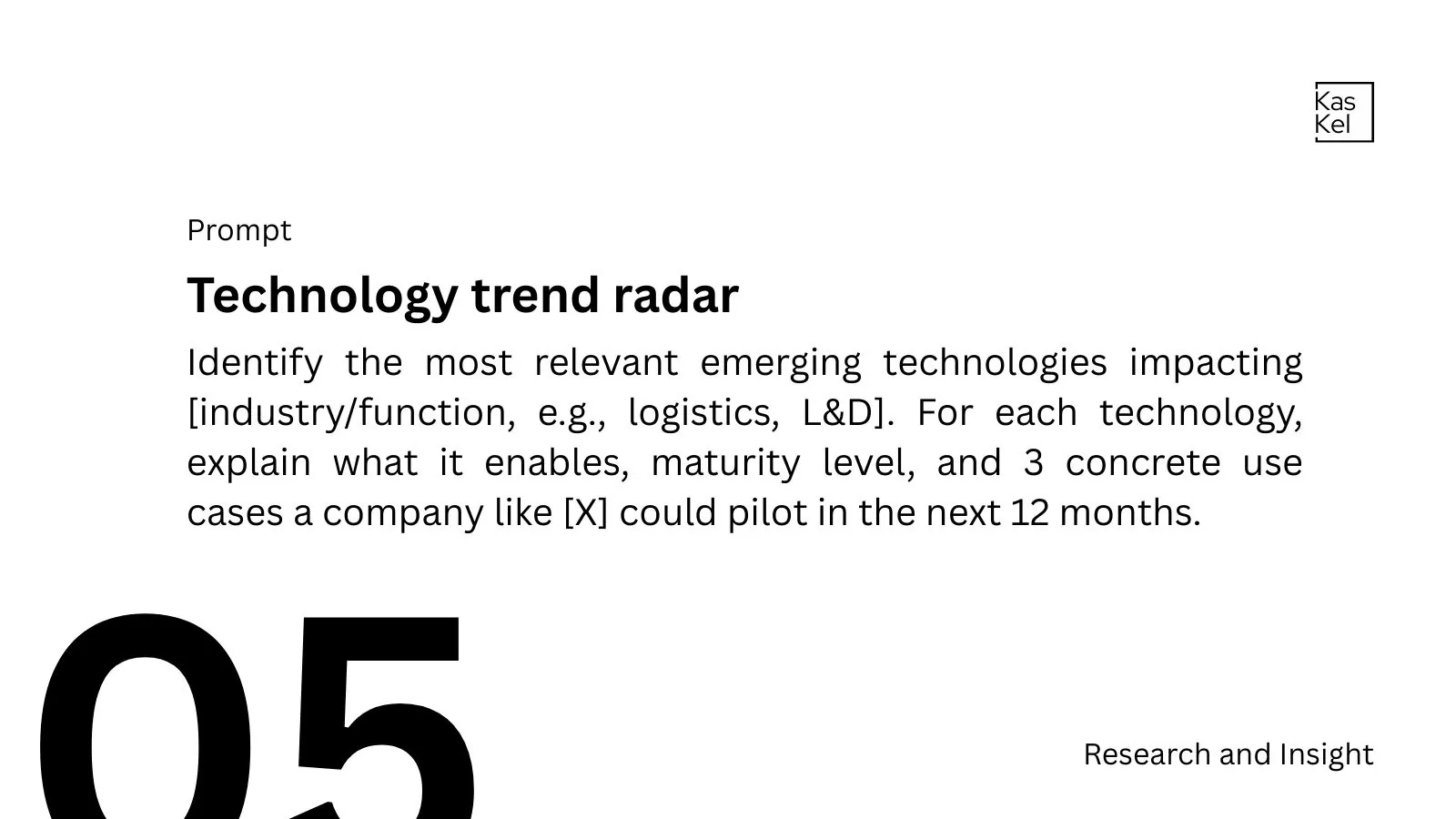
05

Technology trend radar

Identify the most relevant emerging technologies impacting [industry/function, e.g., logistics, L&D]. For each technology, explain what it enables, maturity level, and 3 concrete use cases a company like [X] could pilot in the next 12 months.

View post
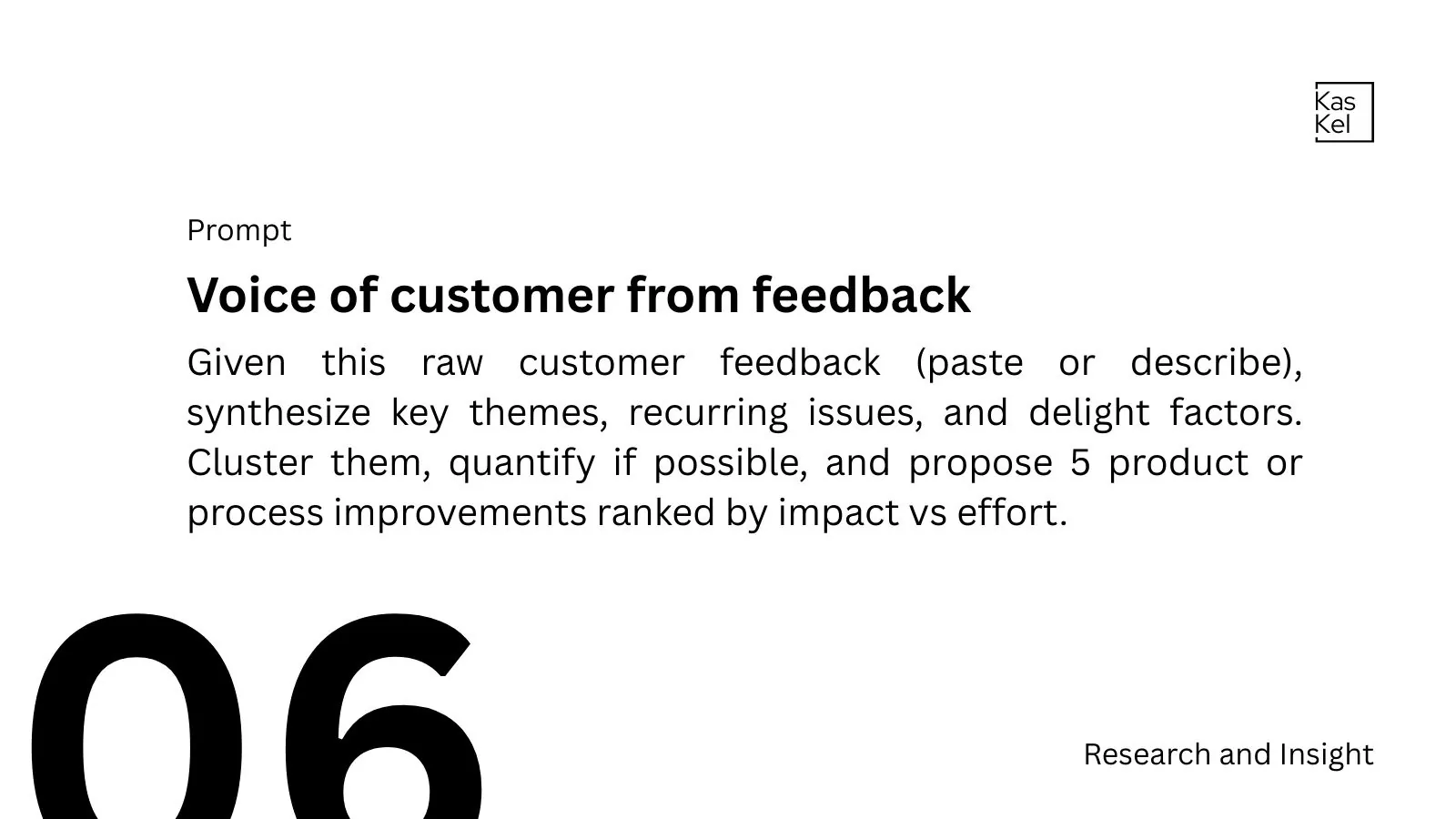
06

Voice of customer from feedback

Given this raw customer feedback (paste or describe), synthesize key themes, recurring issues, and delight factors. Cluster them, quantify if possible, and propose 5 product or process improvements ranked by impact vs effort.

View post
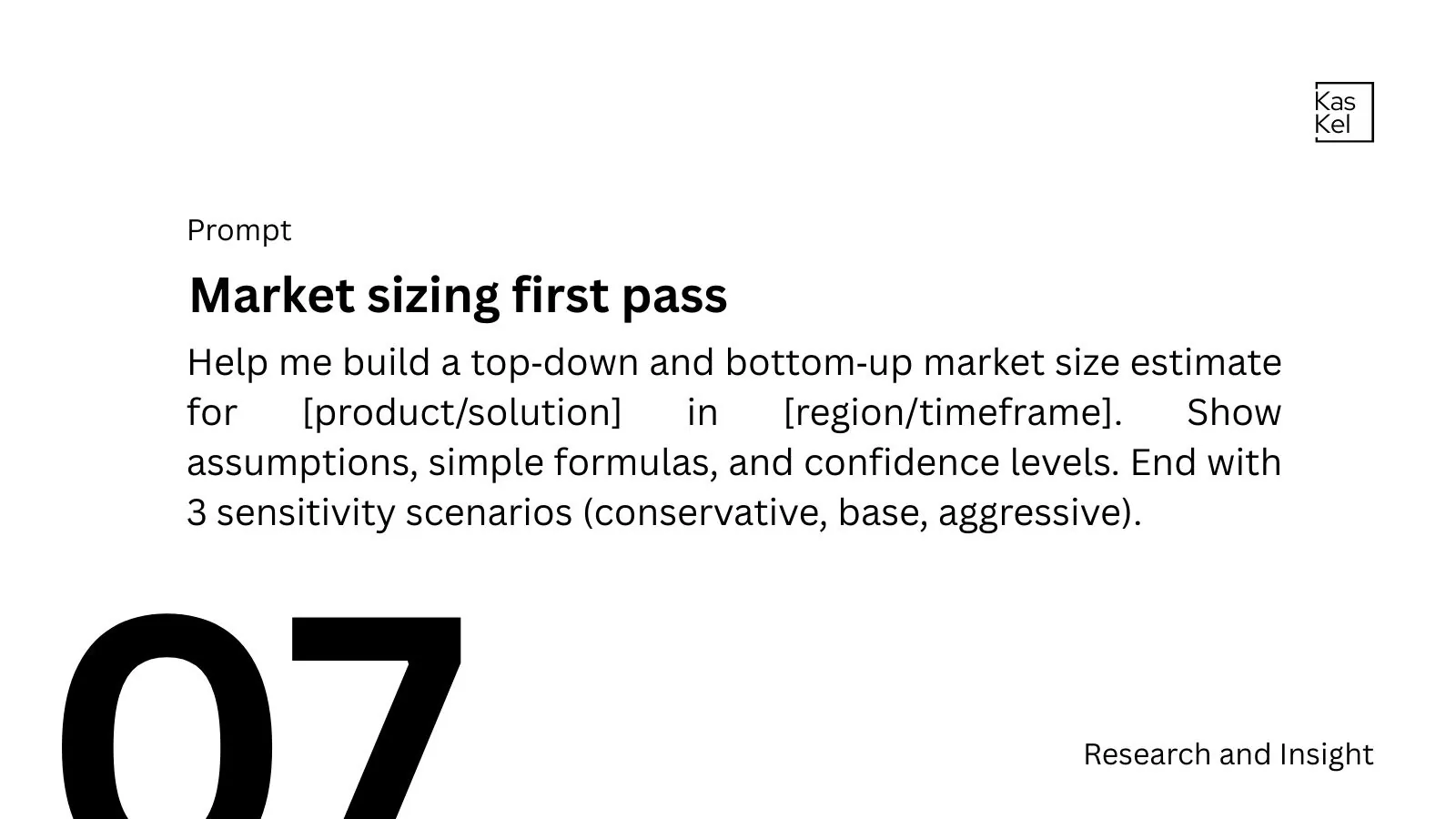
07

Market sizing first pass

Help me build a top-down and bottom-up market size estimate for [product/solution] in [region/timeframe]. Show assumptions, simple formulas, and confidence levels. End with 3 sensitivity scenarios (conservative, base, aggressive).

View post
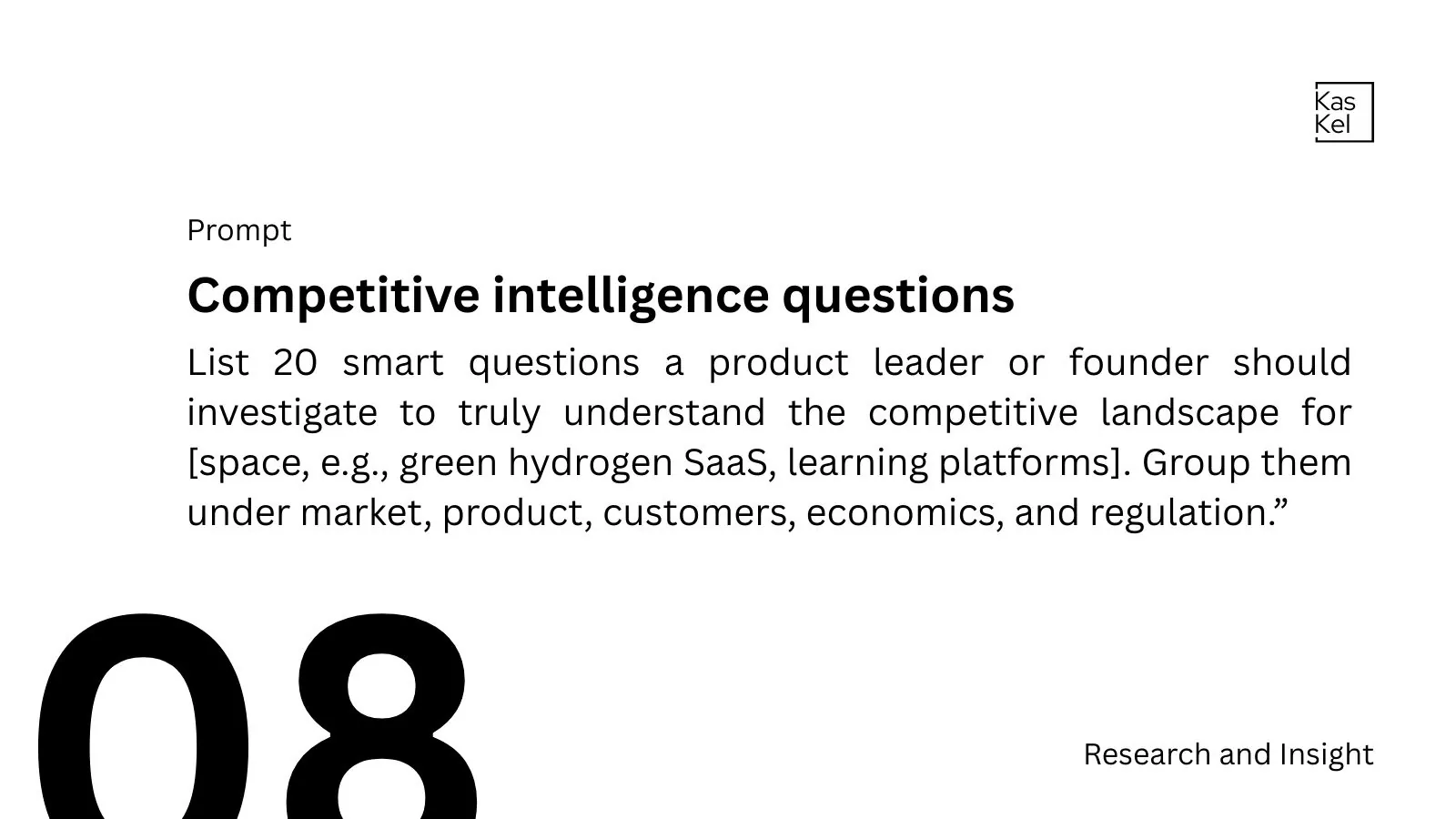
08

Competitive intelligence questions

List 20 smart questions a product leader or founder should investigate to truly understand the competitive landscape for [space, e.g., green hydrogen SaaS, learning platforms]. Group them under market, product, customers, economics, and regulation.

View post
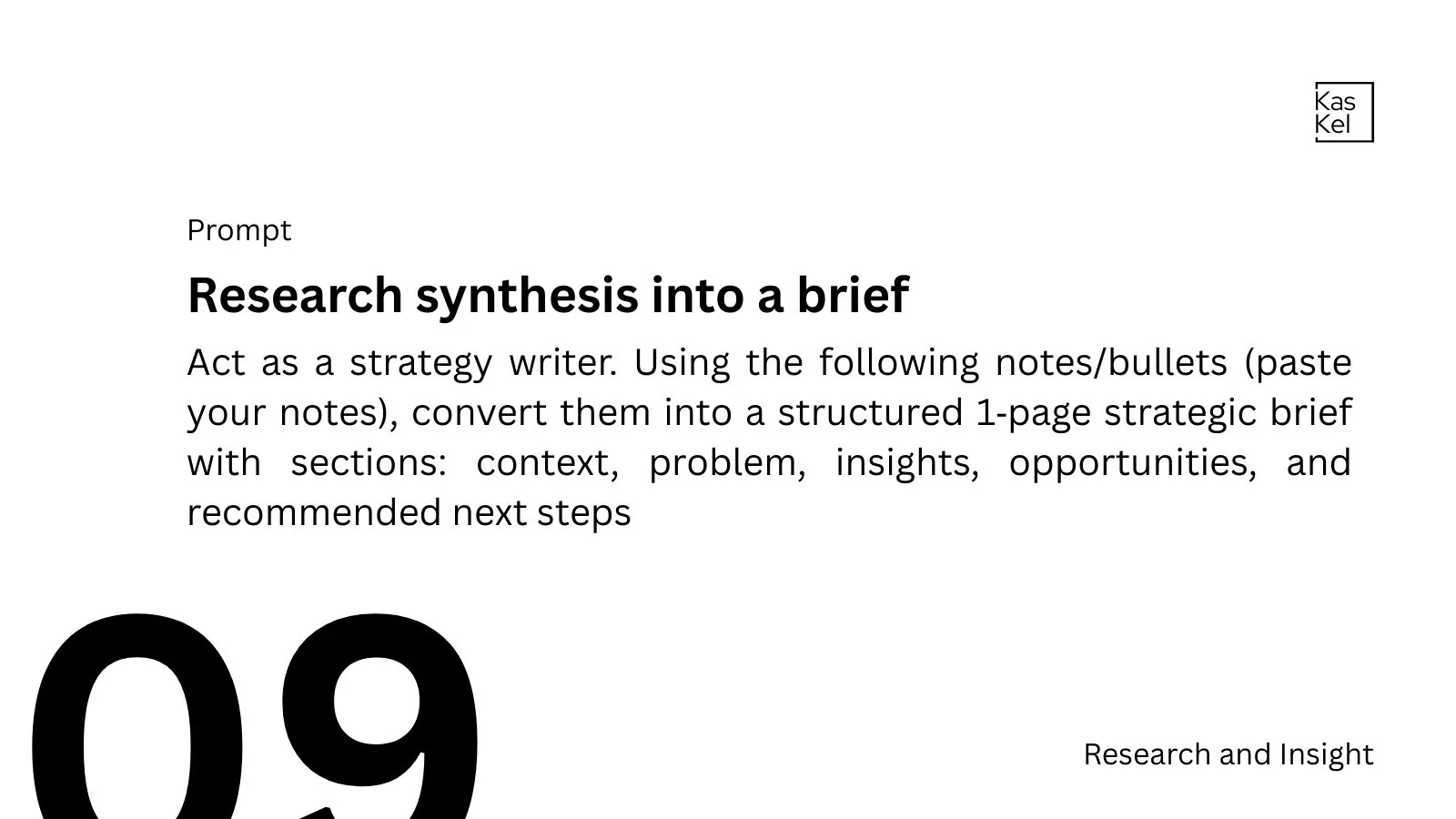
09

Research synthesis into a brief

Act as a strategy writer. Using the following notes/bullets (paste your notes), convert them into a structured 1-page strategic brief with sections: context, problem, insights, opportunities, and recommended next steps na

View post

Part 2 · Prompts 10–18

Product Development & Innovation

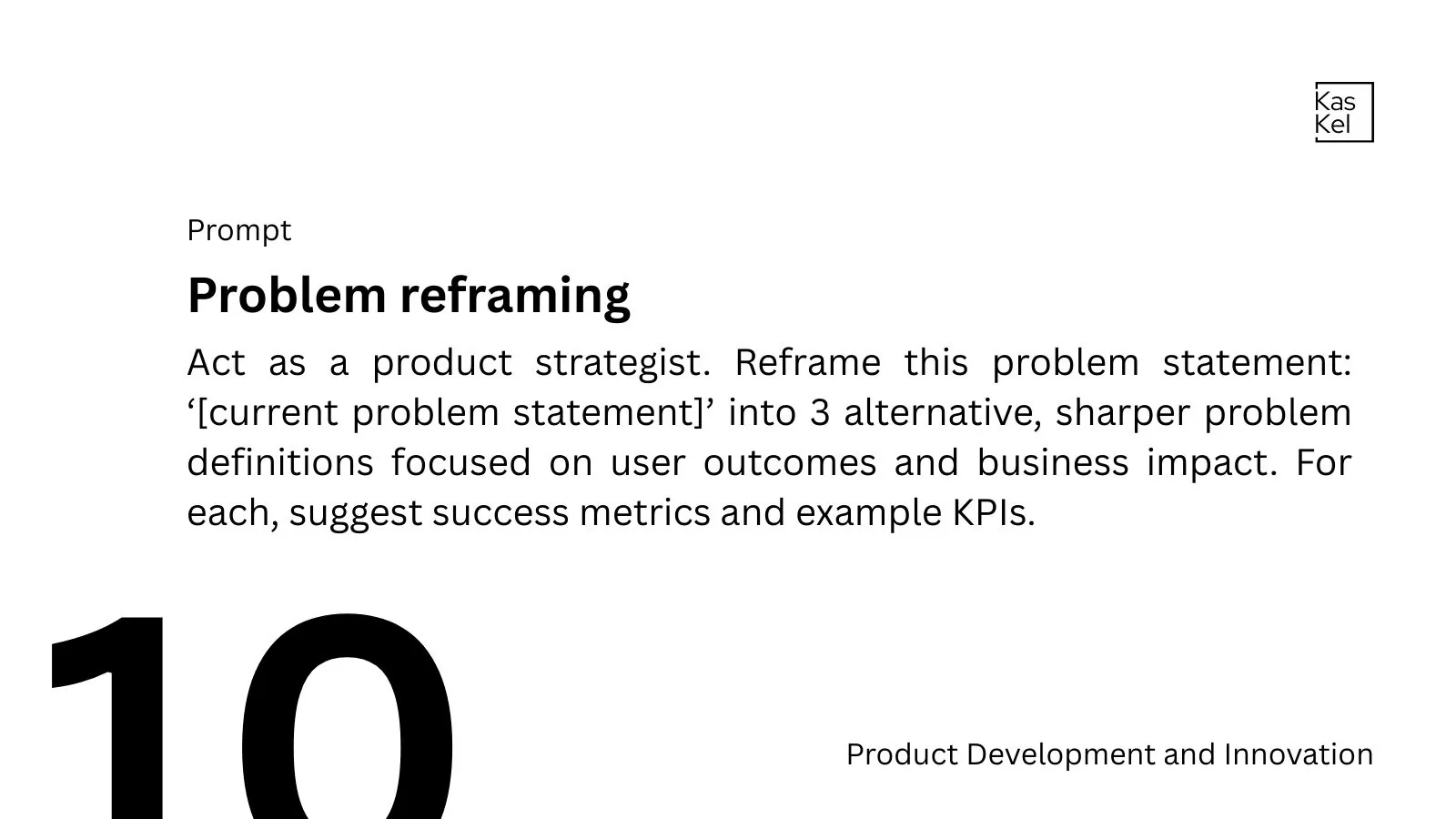
10

Problem reframing

Act as a product strategist. Reframe this problem statement: ‘[current problem statement]’ into 3 alternative, sharper problem definitions focused on user outcomes and business impact. For each, suggest success metrics and example KPIs.

View post
11

Solution idea generation

Generate 20 unconventional but plausible solution ideas for the problem: [describe problem]. Draw analogies from at least 3 other industries and label each idea with its expected impact (high/medium/low) and complexity (high/medium/low).

View post
12

Feature prioritization with frameworks

Using the list of potential features below (paste list), apply a RICE or MoSCoW prioritization and output a table with priority, reasoning, and expected user impact. Call out 3 features that should be in the first MVP.

View post
13

User personas and journeys

Create 3–4 detailed personas for [target users, e.g., frontline associates, plant engineers]. For each persona, map a simple end-to-end journey using [product/process] and highlight key pain points and moments of truth.

View post
14

MVP scoping

Design a realistic MVP for [product idea]. Describe: core problem, target persona, top 3 must-have features, nice-to-have features (later), technical assumptions, and constraints (budget, timeline, team). Keep it lean but testable.

View post
15

Experiment and hypothesis design

Act as a product discovery coach. Propose 5–8 experiments to validate assumptions about [product/feature]. For each, define the hypothesis, experiment type (survey, prototype test, A/B, etc.), sample size idea, and decision thresholds.

View post
16

Requirement and PRD drafting

Turn this idea description (paste) into a concise Product Requirement Document with sections: objective, background, user stories, functional requirements, non-functional requirements, risks, and open questions.

View post
17

Business model and economics sketch

Sketch a simple business model for [product/service]. Describe customer segments, value proposition, channels, revenue streams, and cost drivers. Then outline a basic unit economics view with assumptions and break-even logic.

View post
18

Product roadmap outline (12 months)

Create a 12-month high-level product roadmap for [product]. Group work into quarters with themes (e.g., 'MVP launch', 'scale & reliability', 'expansion'), major milestones, and success metrics for each quarter.

View post

Part 3 · Prompts 19–28

Project Management & Execution

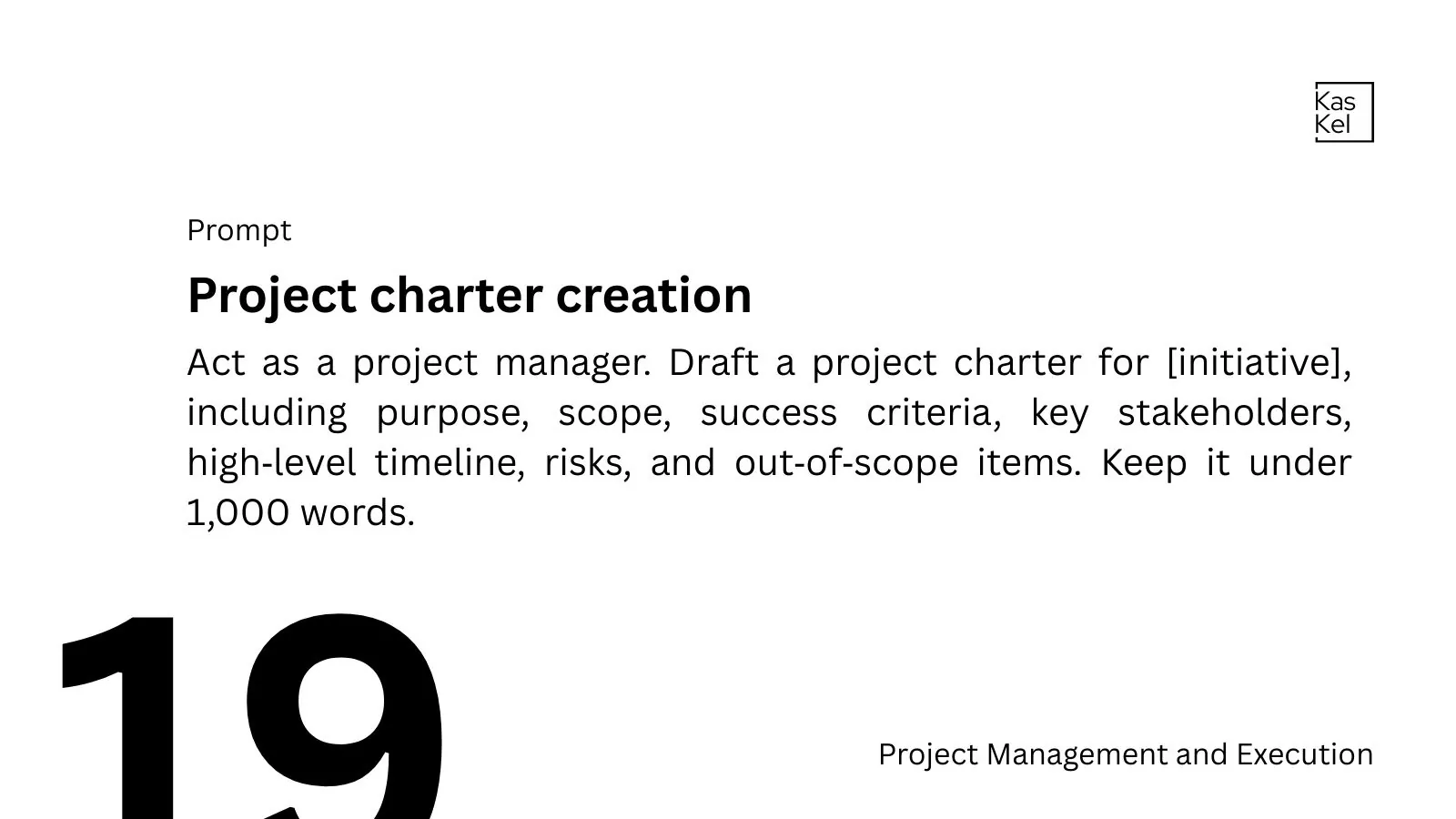
19

Project charter creation

Act as a project manager. Draft a project charter for [initiative], including purpose, scope, success criteria, key stakeholders, high-level timeline, risks, and out-of-scope items. Keep it under 1,000 words.

View post
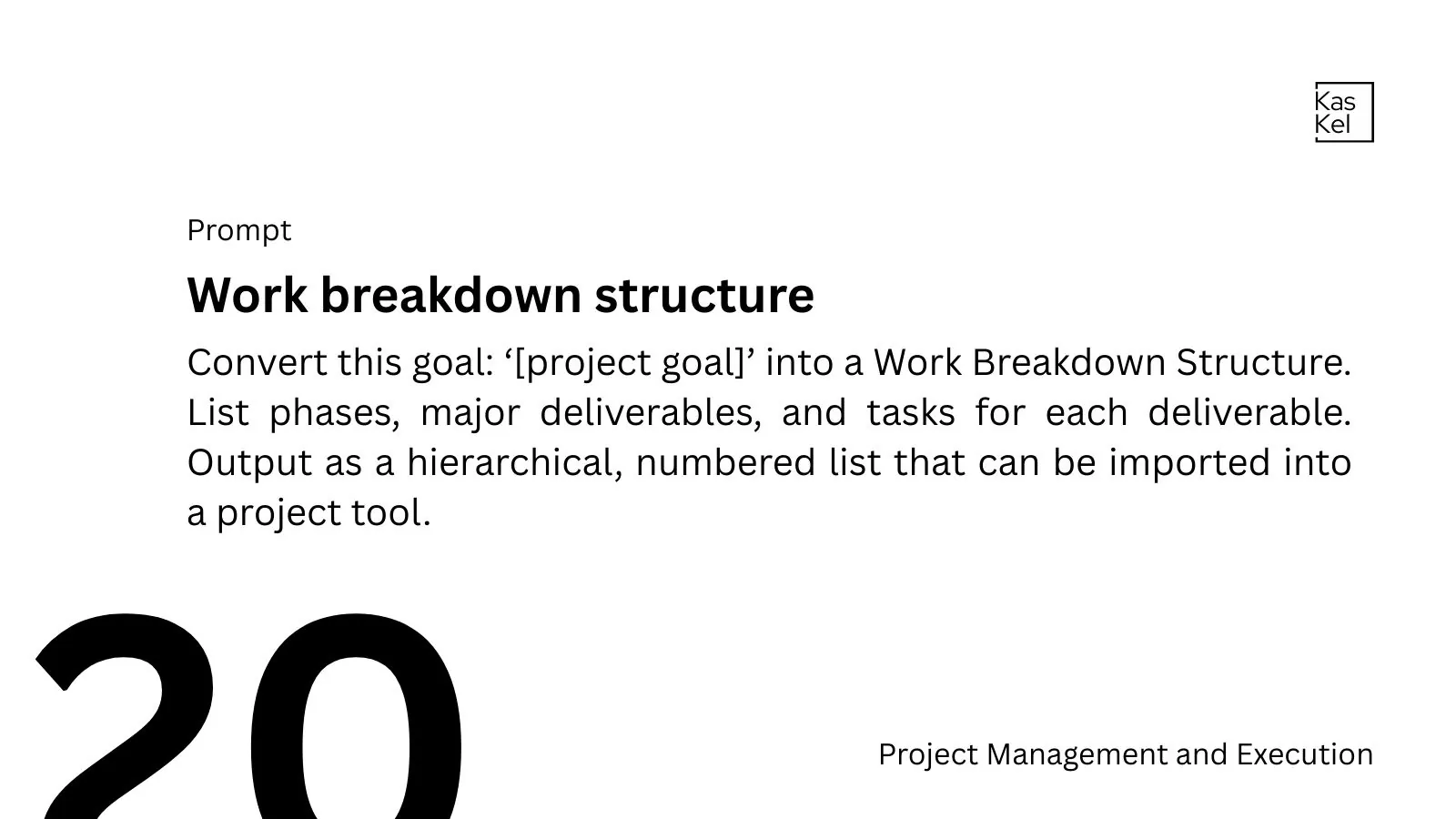
20

Work breakdown structure

Convert this goal: '[project goal]' into a Work Breakdown Structure. List phases, major deliverables, and tasks for each deliverable. Output as a hierarchical, numbered list that can be imported into a project tool.

View post
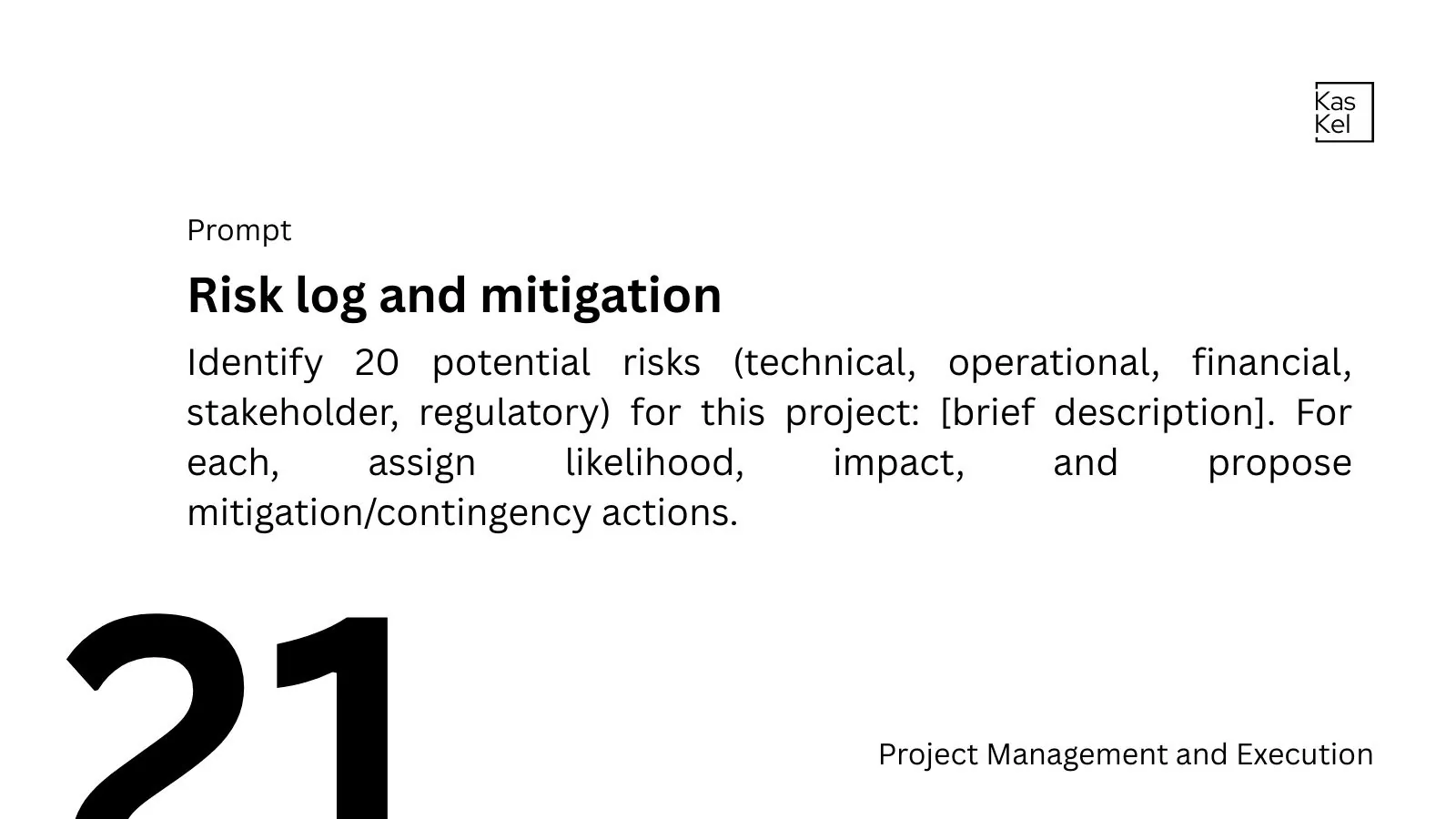
21

Risk log and mitigation

Identify 20 potential risks (technical, operational, financial, stakeholder, regulatory) for this project: [brief description]. For each, assign likelihood, impact, and propose mitigation/contingency actions.

View post
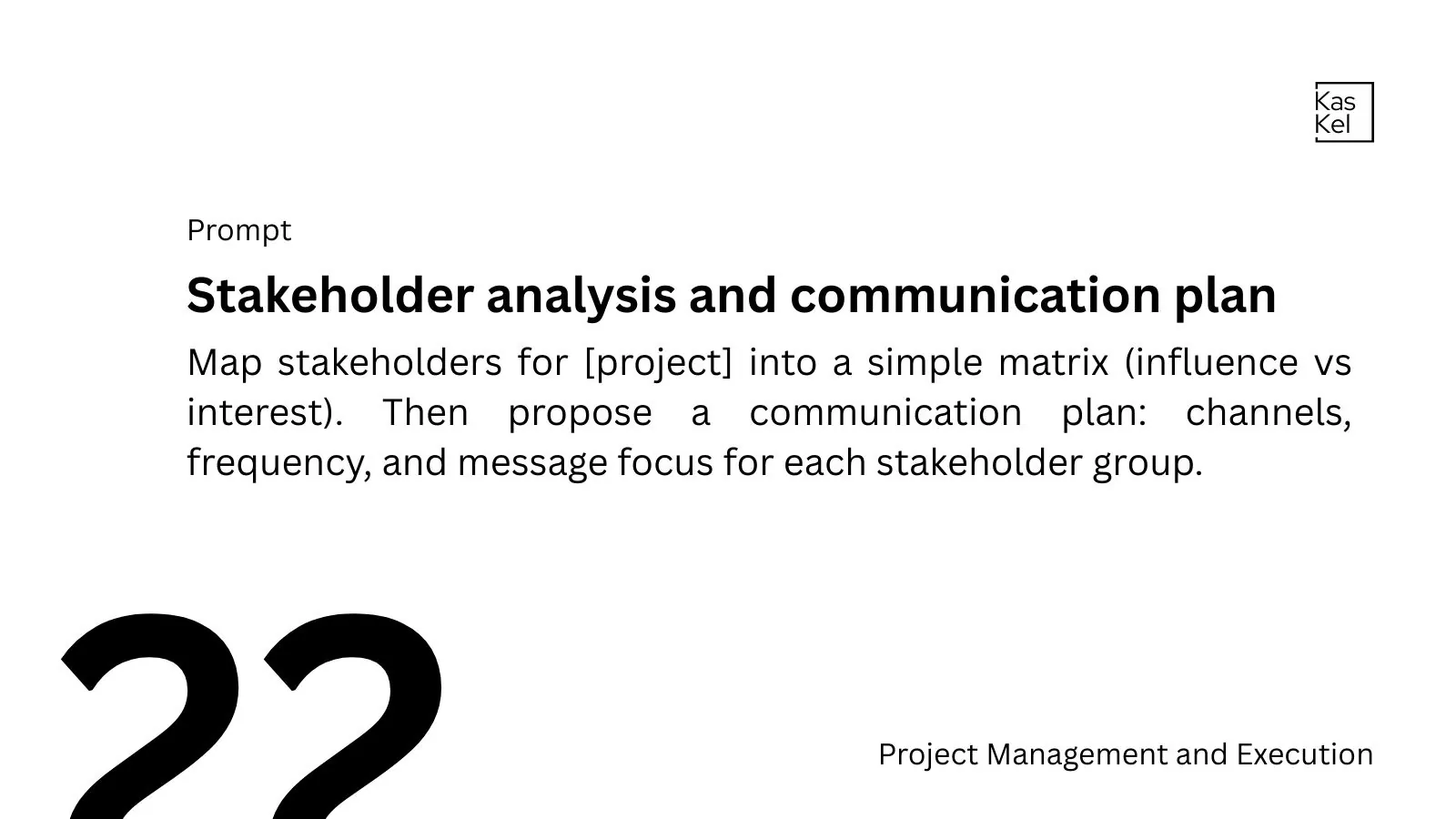
22

Stakeholder analysis and communication plan

Map stakeholders for [project] into a simple matrix (influence vs interest). Then propose a communication plan: channels, frequency, and message focus for each stakeholder group.

View post
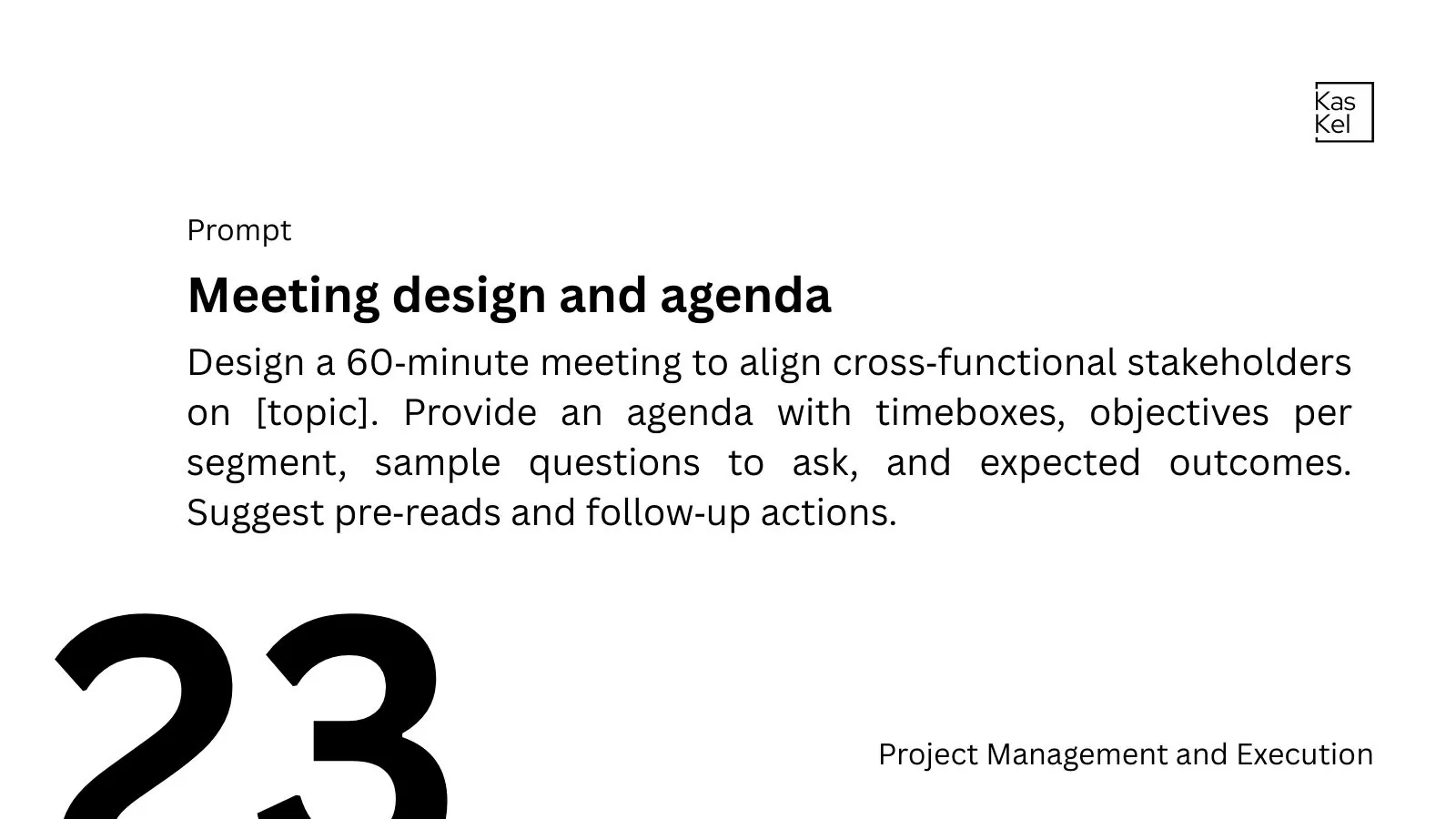
23

Meeting design and agenda

Design a 60-minute meeting to align cross-functional stakeholders on [topic]. Provide an agenda with timeboxes, objectives per segment, sample questions to ask, and expected outcomes. Suggest pre-reads and follow-up actions.

View post
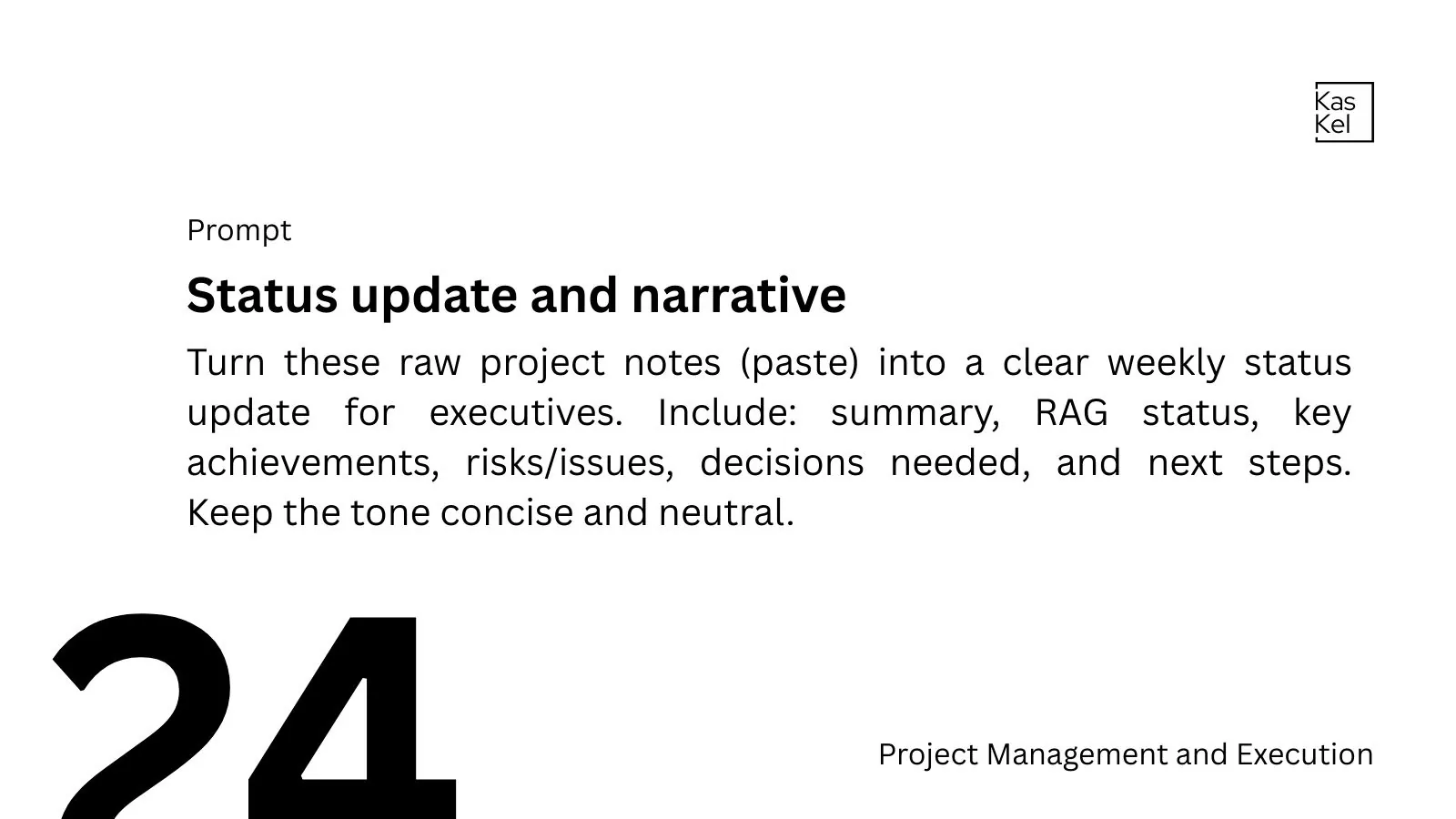
24

Status update and narrative

Turn these raw project notes (paste) into a clear weekly status update for executives. Include: summary, RAG status, key achievements, risks/issues, decisions needed, and next steps. Keep the tone concise and neutral.

View post
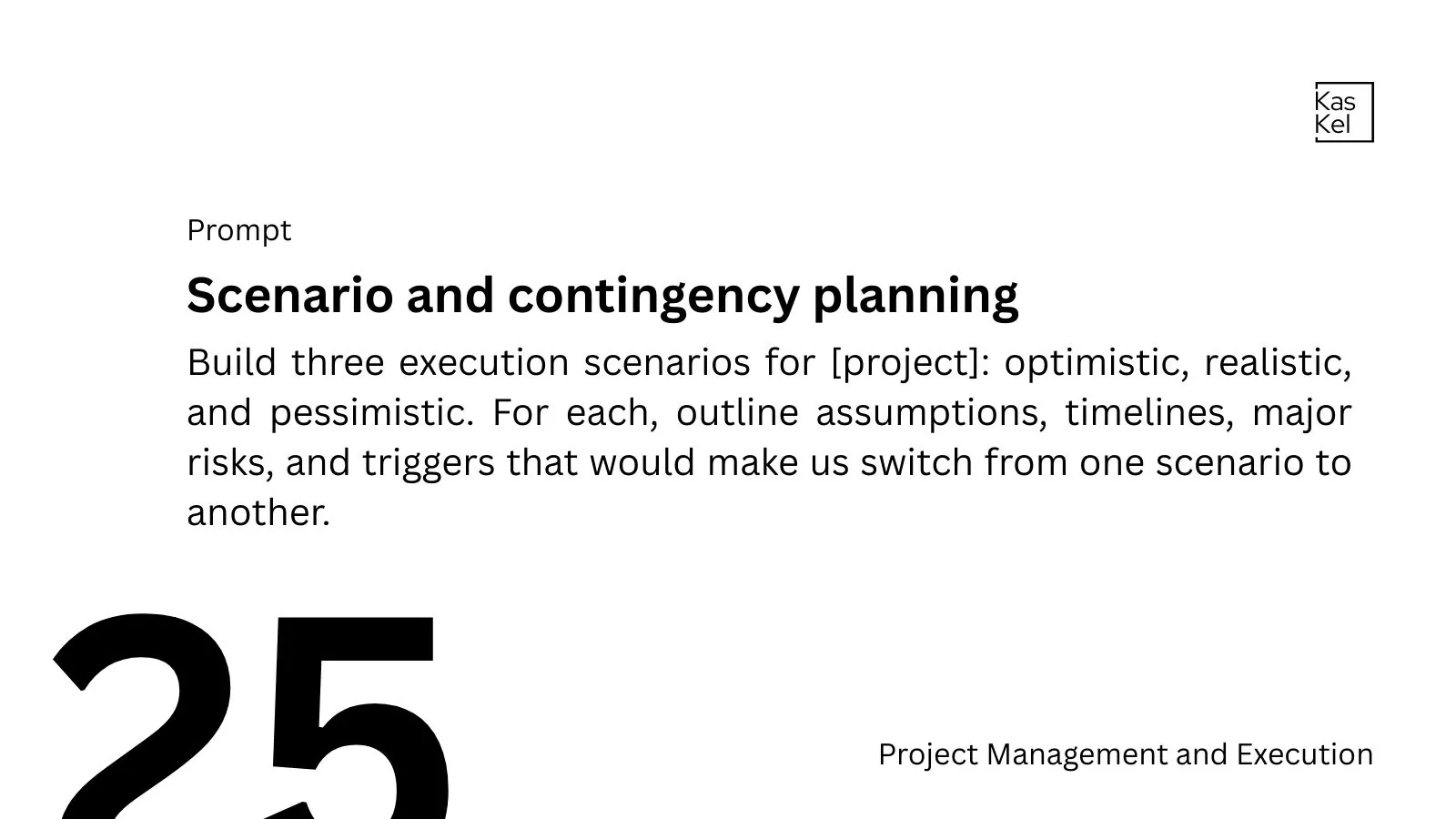
25

Scenario and contingency planning

Build three execution scenarios for [project]: optimistic, realistic, and pessimistic. For each, outline assumptions, timelines, major risks, and triggers that would make us switch from one scenario to another.

View post
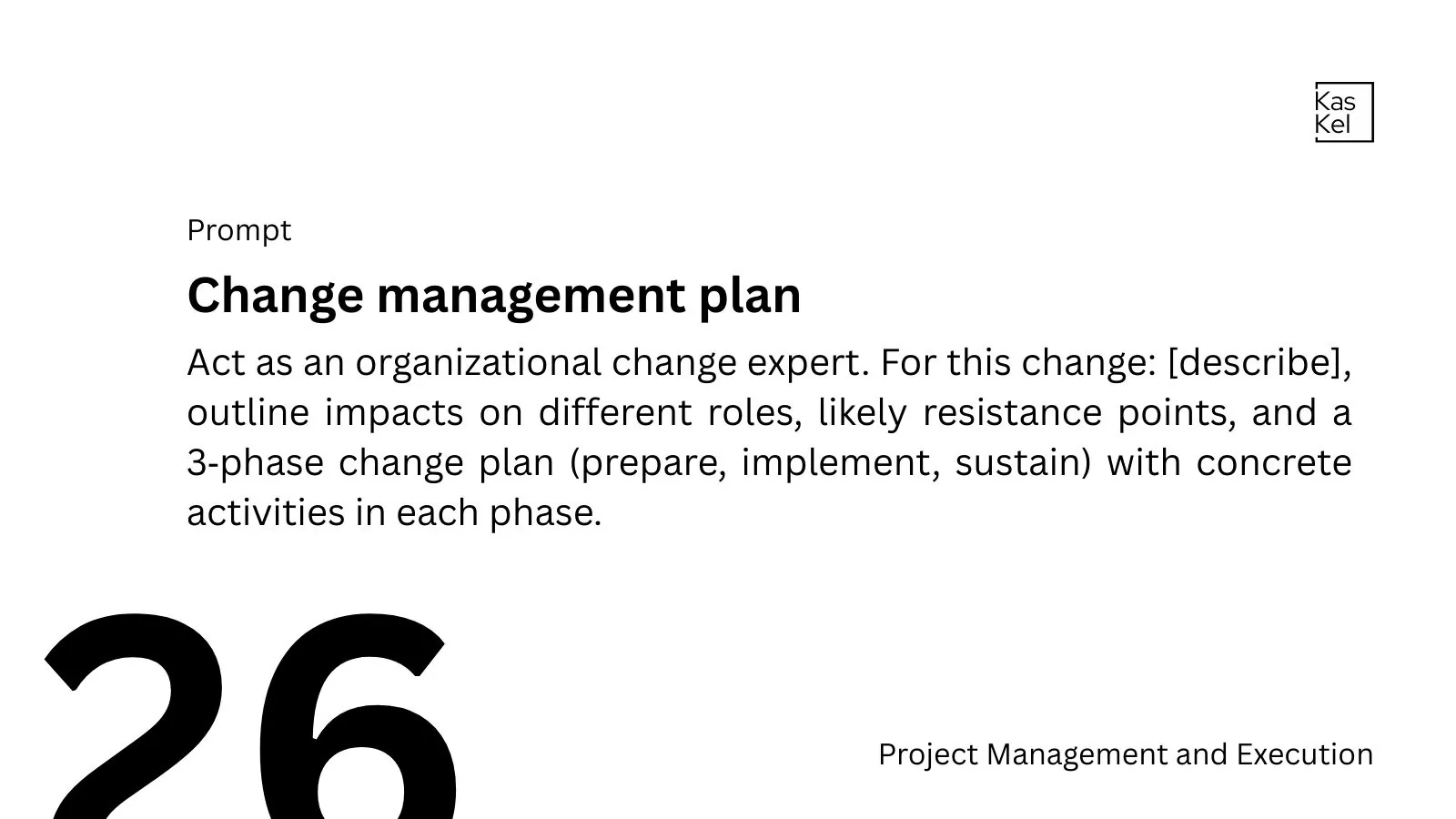
26

Change management plan

Act as an organizational change expert. For this change: [describe], outline impacts on different roles, likely resistance points, and a 3-phase change plan (prepare, implement, sustain) with concrete activities in each phase.

View post
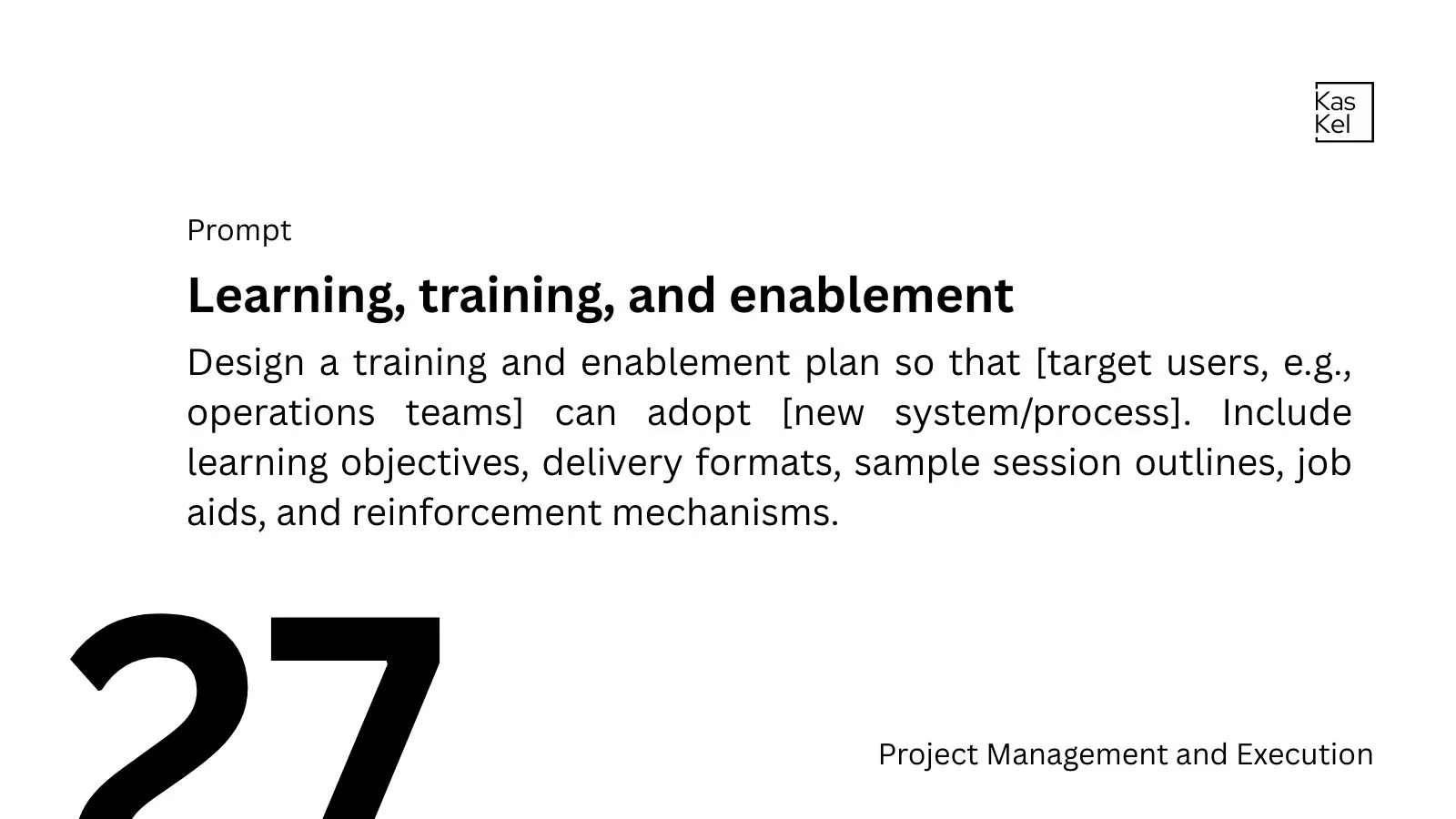
27

Learning, training, and enablement

Design a training and enablement plan so that [target users, e.g., operations teams] can adopt [new system/process]. Include learning objectives, delivery formats, sample session outlines, job aids, and reinforcement mechanisms.

View post
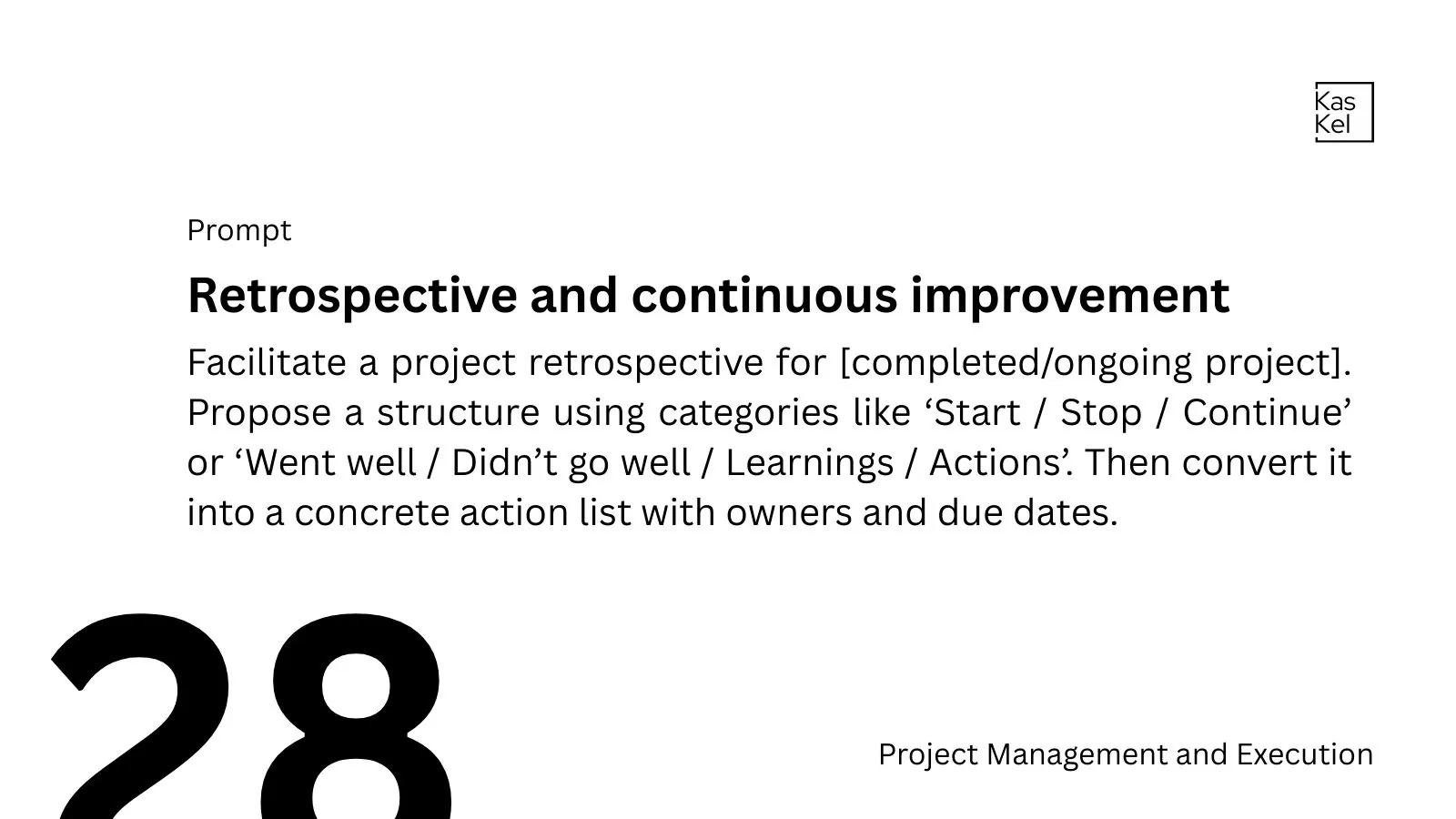
28

Retrospective and continuous improvement

Facilitate a project retrospective for [completed/ongoing project]. Propose a structure using categories like 'Start / Stop / Continue' or 'Went well / Didn't go well / Learnings / Actions’. Then convert it into a concrete action list with owners and due dates.
View post